Pila Mesh vs Bluetti FridgePower: Which Plug-In Apartment Backup Is Better for a Refrigerator?
Apartment buyers often compare battery capacity first, but refrigerator backup can fail on a more basic issue: whether the unit can handle the compressor's startup demand from the outlet where the fridge actually sits. This head-to-head comparison separates Pila Mesh's higher power output and mesh-style apartment fit from Bluetti FridgePower's larger capacity range and fridge-oriented design.
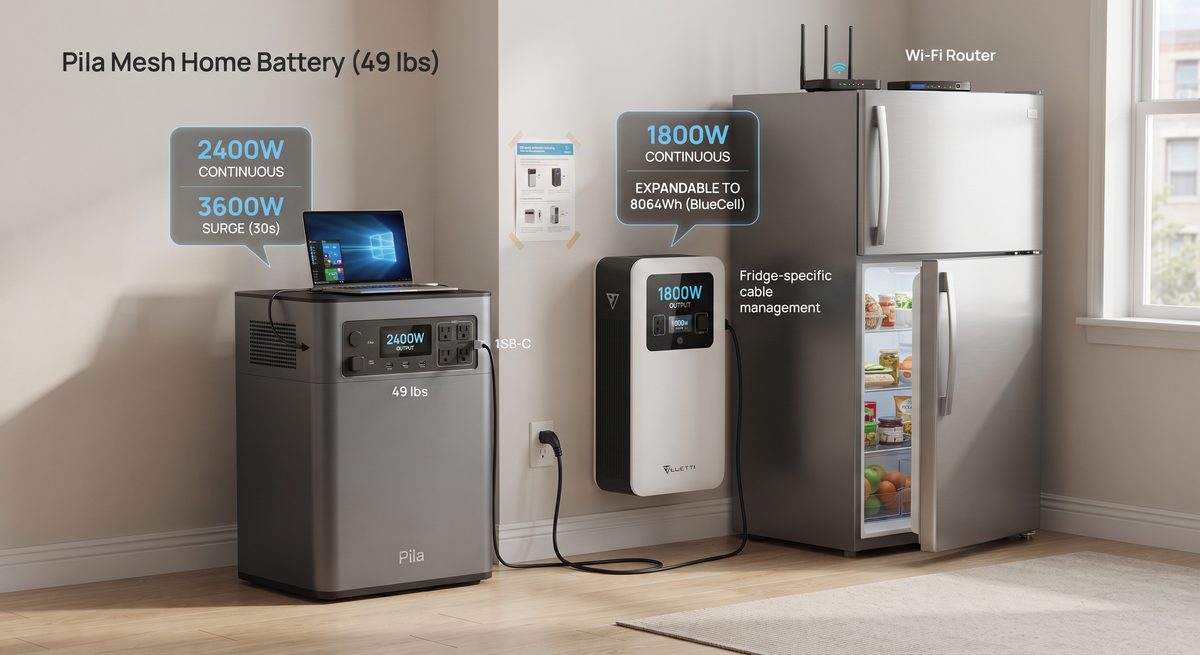
Pila Mesh vs Bluetti FridgePower comes down to more than stored energy. A refrigerator's compressor can demand a short startup surge from the same outlet where the battery is installed, so continuous output, surge headroom, and placement all matter.
This comparison is for renters and condo owners who cannot modify a breaker panel or install a transfer switch. It covers refrigerator runtime, Wi-Fi and laptop loads, UPS behavior, apartment floor space, and whether Pila Mesh's higher output or FridgePower's larger expandable capacity better fits the outage. For a wider apartment shortlist, start with Best Apartment Backup Batteries.
Runtime
Estimate days of backup
Run your refrigerator and essential-device loads through GridMatch's runtime calculator, then compare the resulting capacity and surge needs against the Pila Mesh and Bluetti FridgePower product pages before choosing the smaller or more expandable apartment setup.
Free · No signup · ~30 sec
Quick take
- Best for compressor-startup headroom: Pila Mesh, with 2,400 W continuous output versus FridgePower's 1,800 W, and a documented 30-second 3,600 W surge. FridgePower lists the same 3,600 W surge peak but does not specify duration.
- Best for tight apartment placement: Bluetti FridgePower, with a 75 mm wall-oriented, fridge-first layout. Wall mounting can save floor space, but drilling often needs landlord or lease approval.
- Best for compact multi-day refrigerator backup: Bluetti FridgePower with BlueCell expansion, reaching 8,064 Wh while keeping the same 1,800 W output.
- Best for distributed room-by-room backup: Pila Mesh, whose mesh pairing can connect up to 64 units, although that is not the same as a panel-tied whole-home system.
Output versus runtime is the real split
Pila Mesh: the safer choice when startup demand is uncertain
The Pila Mesh Home Battery is the better fit when the refrigerator's compressor startup is the main concern. It supplies 2,400 W continuously, 3,600 W of surge power for 30 seconds, and a published 65 A RMS startup rating. FridgePower also lists 3,600 W of surge power, but its continuous rating is 1,800 W and it does not publish a surge duration. Everyday fridge-plus-router running watts fit either inverter. The extra 600 W of continuous headroom matters when the compressor starts while a laptop or another AC load is already running, or if you add a kettle or similar kitchen load.
The tradeoff is its smaller 1,600 Wh base capacity and heavier 49 lb body with no wheels. The chassis is still meant to live in a room rather than a garage: it can lay flat, stand on its side, hang on a wall, or slide into a cabinet. The vertical stand and wall bracket are separate accessories, and wall drilling may need permission. Mesh expansion can become a multi-unit setup rather than a single appliance beside the fridge. Pila also has no native 240V output, so its higher output does not turn it into a whole-home or panel-connected system.
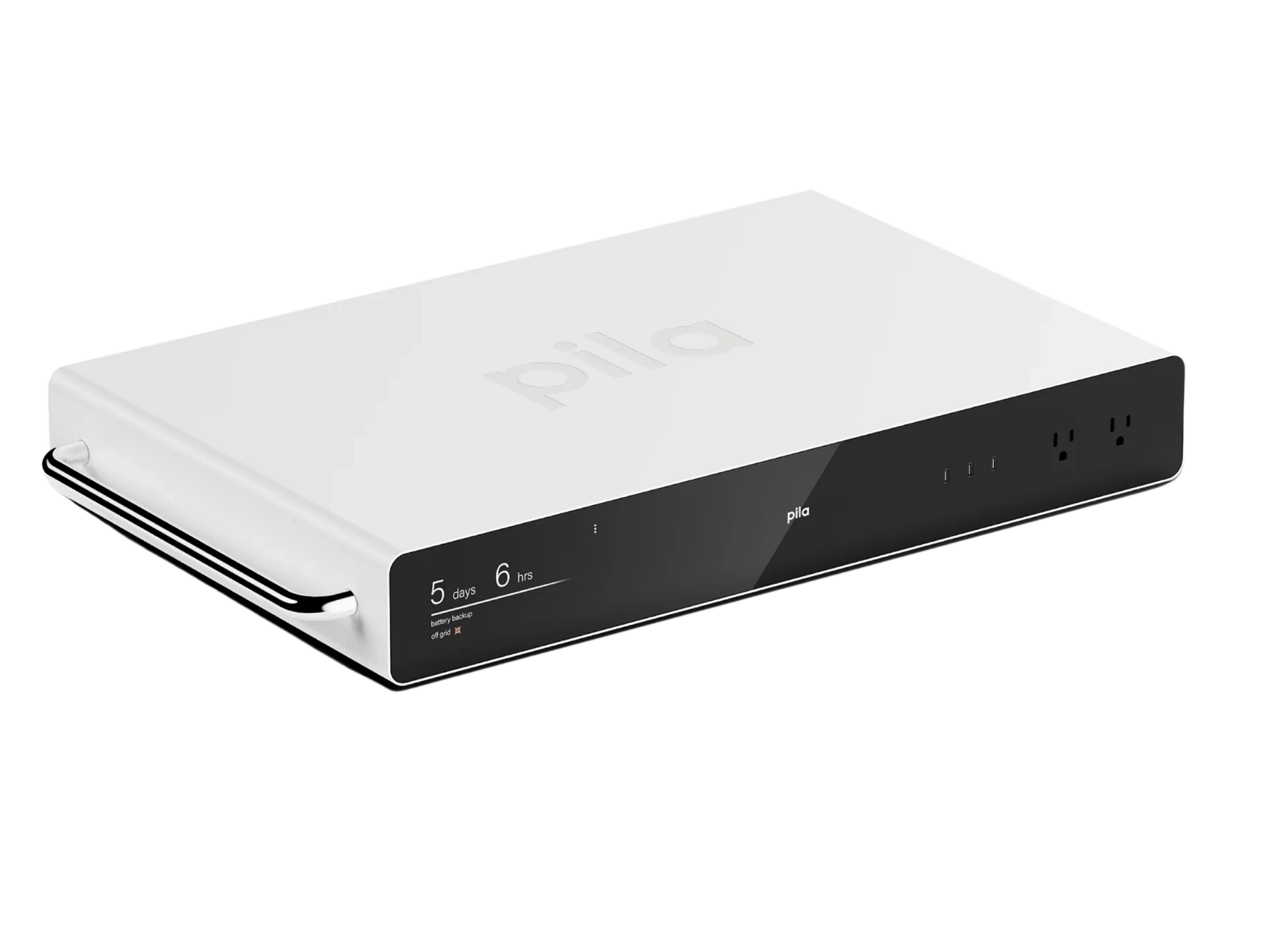
Pila Mesh Home Battery
1.6 kWh plug-in LFP mesh backup, 2400 W, ~10–20 ms UPS — apartment / essentials.
Bluetti FridgePower: the better fit when runtime and location come first
The Bluetti FridgePower is the more practical choice when the battery needs to sit directly beside the refrigerator and run essentials for longer. Its 2,016 Wh base capacity is larger than Pila Mesh's 1,600 Wh, and the system can expand to 8,064 Wh with BlueCell 200 batteries. The 75 mm profile can sit beside the fridge, go flat or vertical, or mount on a wall. Mounting hardware is included, but a lease that forbids wall drilling still leaves the freestanding placements.
The tangible compromise is lower continuous output: 1,800 W versus Pila's 2,400 W. Expansion increases runtime, not compressor-startup headroom, because the system remains rated at 1,800 W continuous and 3,600 W surge. At 41.9 lbs it is lighter than Pila, but it also has no wheels and only two AC outlets versus Pila's four. That is enough for a fridge-first setup, but tight if the same box also has to feed a router and a work-from-home load.
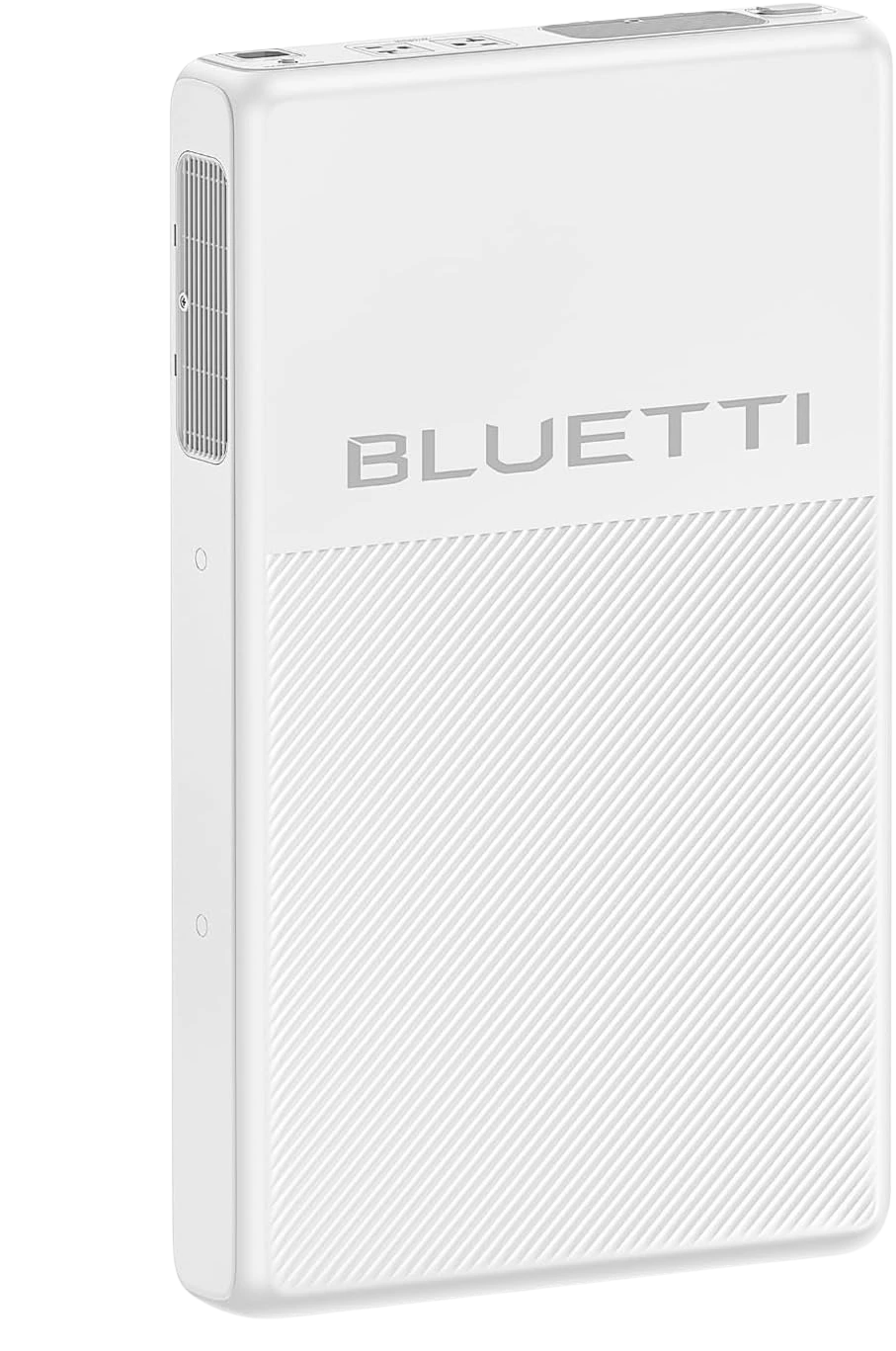
Bluetti FridgePower
3 configurations
2.02–8.06 kWh ultra-slim LFP, 1800 W, ~10 ms UPS — fridge/apartment backup.
Runtime depends on average watts, not the refrigerator label alone
Use this basic calculation:
Daily energy need in kWh = watts × hours ÷ 1,000
For a refrigerator, use its average consumption over time rather than treating its running wattage as constant. Compressors cycle. A modern apartment fridge often lands closer to 1–1.5 kWh per day (roughly 40–60 W averaged), while an older or less efficient unit can approach 2 kWh per day or more. The EnergyGuide kWh/year figure divided by 365, or a plug-in meter, is more useful than the compressor's nameplate watts.
A simple illustrative apartment load might look like this:
- Refrigerator averaging 50 W for 24 hours: 1.2 kWh
- Wi-Fi router using 15 W for 24 hours: 0.36 kWh
- Laptop using 60 W for 4 hours: 0.24 kWh
- Total AC load: 1.8 kWh per day
Because these loads use an AC inverter, allow roughly 10–15% for conversion losses. That 1.8 kWh load therefore requires about 2.00–2.12 kWh from the battery before accounting for the unit's own idle draw. The actual result will vary with the refrigerator's duty cycle, room temperature, door openings, and startup behavior.
Pila Mesh's 1,600 Wh base battery provides roughly 1.36–1.44 kWh after that AC derate in a simplified estimate. Bluetti FridgePower's 2,016 Wh base provides about 1.71–1.81 kWh. On the mixed 1.8 kWh day above, Pila's base pack is short, and FridgePower is close but still not a comfortable full-day reserve after losses and idle draw.
Chart
Chart unavailable
For an apples-to-apples comparison, a constant 100 W AC load is a conservative combined-essentials average, not a typical fridge-only figure. It is the right planning number when the refrigerator is less efficient, the kitchen is hot, or a laptop and lights share the battery. At 100 W, those derated estimates translate to approximately 13.6–14.4 hours for Pila and 17.1–18.1 hours for FridgePower, before idle draw.
Fridge-only coverage is often longer than that 100 W yardstick, and sometimes it is not. An efficient cycling refrigerator averaging about 50 W can stretch both base packs past 24 hours in a simplified estimate. A hungrier fridge averaging closer to 100 W will not. Pila's own materials put an average fridge around 24–32 hours. Measure your unit when possible.
Idle draw also matters on a cycling fridge, because the inverter may stay awake between compressor runs. FridgePower publishes a 4 W self-consumption figure. Pila lists inverter-on idle under 10 W. Neither number replaces a meter reading, but FridgePower's published idle is the lower of the two.
For a multi-day outage, FridgePower's expansion range is easier to size in steps: approximately 4,032 Wh with one BlueCell 200, approximately 6,048 Wh with two, and up to 8,064 Wh. Pila Mesh lists a single-unit expansion pack that doubles storage toward 3.2 kWh; treat that as a listed accessory and confirm current shipping dates rather than assuming it arrives in the same box. The 102,400 Wh maximum is a distributed mesh ceiling of up to 64 units, not one 102.4 kWh battery with one set of outlets or whole-home output.
Surge and UPS behavior are different buying questions
A refrigerator's average draw determines runtime, but its compressor startup can determine whether backup begins successfully. Check the refrigerator's nameplate data or manufacturer documentation when available, then compare the starting requirement with the battery's surge and continuous ratings. Neither product's rating guarantees compatibility with every compressor.
Pila Mesh has the stronger continuous-output position at 2,400 W, with 3,600 W surge for 30 seconds and 65 A RMS startup current. Bluetti FridgePower lists 1,800 W continuous and the same 3,600 W surge rating, but no surge duration is provided in the product data. That makes Pila the more forgiving option if the refrigerator starts while a laptop or other AC device is already running.
Chart
Chart unavailable
UPS timing matters more for the router and other always-on electronics than for refrigerator runtime. FridgePower consistently lists about 10 ms switchover. Pila's spec table and outage FAQ say 10 ms, while other Pila documentation says 20 ms or less. Treat both as fast plug-in UPS-class transfer in the 10–20 ms range, with FridgePower's published figure more consistently 10 ms. Neither rating is a promise that every router, modem, or laptop will remain online. If uninterrupted network service is essential, test the actual equipment or keep a separate UPS for sensitive networking gear.
A common failure point is sizing only for the refrigerator's running wattage. The compressor may be fine once running but still trip a unit during startup if other loads are active.
Apartment placement can matter as much as capacity
Neither system requires breaker-panel work for its basic plug-in setup, which is the main advantage for renters. The battery must still be placed close enough to the refrigerator and other essentials for a practical connection. A larger battery across the room may have more theoretical energy but be less useful if the fridge outlet and router are difficult to reach.
Pila Mesh has four controllable 120V outlets, USB-C, and mesh pairing for room-by-room backup. That layout suits an apartment where the refrigerator is in one area and networking or charging needs are elsewhere. At 49 lb without wheels it is not a casual carry, but orientation flexibility offsets some of that: lay it flat, stand it on its side, tuck it into a cabinet, or use the optional vertical stand. The optional wall bracket has the same lease issue as any other wall mount.
FridgePower is built around fridge and essentials placement, with an ultra-slim 75 mm profile and a lighter 41.9 lb weight. That can be a meaningful advantage beside a refrigerator, on top of it if clearance allows, or in a narrow storage area. Wall placement is not automatically renter-friendly: the box includes mounting hardware, but drilling, anchors, and building rules may require permission. If the lease forbids wall modifications, use the supported freestanding orientations instead. It also does not provide a reason to run unsafe extension arrangements or daisy-chain equipment.
Both products are 120V plug-in solutions rather than native 240V whole-home systems. They cannot power every branch circuit through a breaker panel. A permitted whole-home path requires an appropriate transfer switch or ATS, compatible equipment, and professional installation; renters should not improvise a panel connection or backfeed an apartment circuit.
Expansion changes runtime, not the basic electrical path
Pila Mesh's main expansion advantage is distribution. Up to 64 units can be mesh-paired, allowing capacity and outlets to be placed in different rooms. That can work well for critical loads spread around an apartment, but more units mean more floor space, more charging coordination, and more setup complexity. The system still has no native 240V output.
Bluetti FridgePower takes the simpler capacity path. The base unit starts at 2,016 Wh and can grow to approximately 4.03 kWh, 6.05 kWh, or 8.06 kWh with the listed BlueCell configurations. This is easier to understand for a refrigerator-first backup plan: add battery capacity when the outage duration requires it. The hidden limit is that every configuration remains at 1,800 W continuous and 3,600 W surge, so added batteries do not make it suitable for larger startup loads.
Chart
Chart unavailable
For most apartment buyers, the useful expansion target is the amount of energy needed for the expected outage, not the largest listed capacity. Calculate the refrigerator, router, and charging load first. Then leave room for inverter losses and idle draw instead of buying based on a headline maximum.
When to pick each
| Apartment backup situation | Better fit | Why |
|---|---|---|
| The refrigerator's startup requirement is unclear and other AC loads may run at the same time | Pila Mesh Home Battery | It publishes 2,400 W continuous, 3,600 W surge for 30 seconds, and 65 A RMS startup. FridgePower lists 1,800 W continuous and 3,600 W surge with no duration. |
| The battery must fit beside the fridge in a narrow space | Bluetti FridgePower | Its 75 mm ultra-slim design is more suited to constrained placement, including freestanding options if wall drilling is not allowed. |
| The main goal is longer refrigerator runtime over a multi-day outage | Bluetti FridgePower with BlueCell expansion | It grows from 2,016 Wh to 8,064 Wh without changing the basic plug-in setup or the 1,800 W output cap. |
| Loads are spread between the kitchen, networking area, and another room | Pila Mesh Home Battery | Mesh pairing can distribute up to 64 units, though it does not create a 240V or panel-tied system. |
| The router is sensitive to brief interruptions | Either, with testing | FridgePower consistently lists ~10 ms; Pila's materials list 10 ms and 20 ms. Test the actual modem and router. |
| The goal is whole-home or 240V backup | Neither plug-in option alone | Use a properly designed transfer-switch or ATS system with professional installation and building approval. |
FAQ
Can either battery keep a refrigerator running for 24 hours?
It depends on the refrigerator's average energy use and the other loads connected. A typical modern apartment fridge often uses about 1–1.5 kWh per day, not a constant 100 W. On a 50 W fridge-only average, both base packs can cover more than 24 hours in a simplified derated estimate. A refrigerator averaging 100 W would use 2.4 kWh in 24 hours before adding Wi-Fi, charging, and inverter losses, which exceeds Pila's 1,600 Wh and FridgePower's 2,016 Wh base packs. Add those extra loads and neither base configuration should be treated as a guaranteed full-day mixed-essentials solution.
Is Pila Mesh better because it has the higher surge rating?
Not strictly. Both products list 3,600 W of surge output. Pila Mesh has the higher continuous rating at 2,400 W, lists a 30-second surge duration, and publishes 65 A RMS startup current, while FridgePower lists 1,800 W continuous and does not provide a surge duration in the supplied specifications. Pila is therefore the stronger choice when combined running loads are higher, but the refrigerator's actual startup demand still needs to be checked.
Can a renter connect either product to an apartment breaker panel?
No. These are plug-in 120V backup products, not native 240V panel batteries. Connecting backup power to a panel requires an approved transfer switch or ATS, compatible wiring, professional installation, and permission from the building or property owner. Without that path, use the battery for selected plug-in loads rather than attempting whole-home backup.
Does FridgePower's 10 ms UPS rating make it better for Wi-Fi?
It gives FridgePower the more consistently published ~10 ms figure. Pila's spec table also lists 10 ms, while other Pila documentation says 20 ms or less. That may help equipment that is sensitive to brief interruptions, but it does not guarantee every router, modem, or laptop will stay online. Test the actual network equipment if connectivity during an outage is important.
Is the larger maximum capacity always worth choosing?
No. Bluetti FridgePower's expansion to 8,064 Wh adds runtime but not output power. Pila Mesh's listed 102,400 Wh maximum comes from a mesh system and does not provide one integrated 102.4 kWh outlet bank or 240V whole-home output. Choose capacity based on measured daily loads and expected outage length, then confirm that the output rating handles startup and simultaneous loads.
Takeaway
For Pila Mesh vs Bluetti FridgePower, choose Pila Mesh's smaller 1,600 Wh plug-in base when compressor-startup margin and distributed apartment coverage matter most; choose FridgePower when the fridge needs a slim nearby unit and longer runtime through expansion. Step up to a transfer-switch system for true whole-home or 240V backup, and avoid the common mistake of sizing only by refrigerator running watts while ignoring startup surge and AC conversion loss.
Related guides
These guides cover adjacent buying scenarios worth comparing.
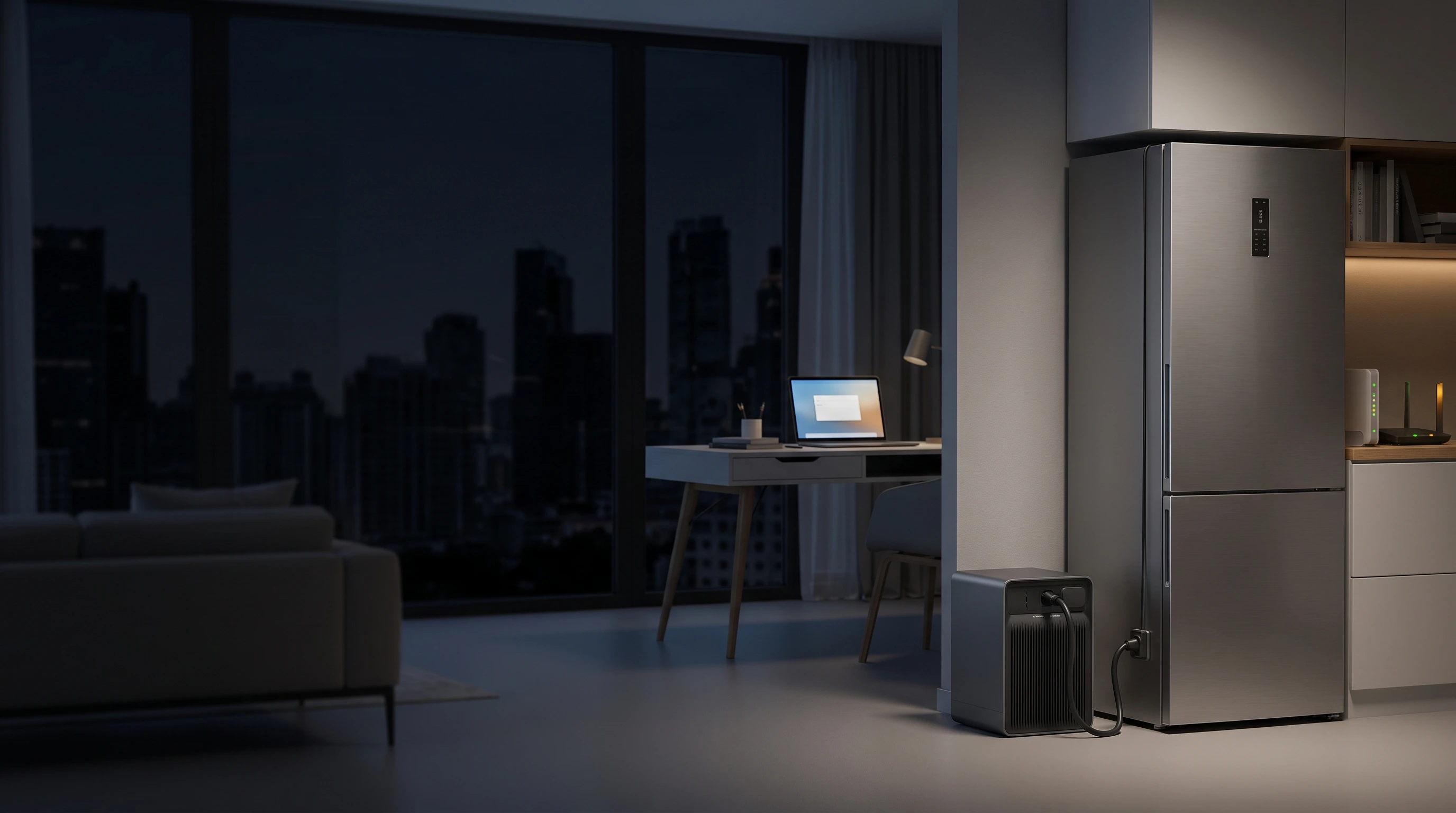
Best Apartment Backup Batteries for Fridge, Wi-Fi, and Work-From-Home Outages
Apartment backup is an outlet-level problem, not miniature whole-home backup. The right battery must handle refrigerator startup, keep internet gear online, fit safely indoors, and work without breaker-panel changes that a renter may not be allowed to make.
Read guide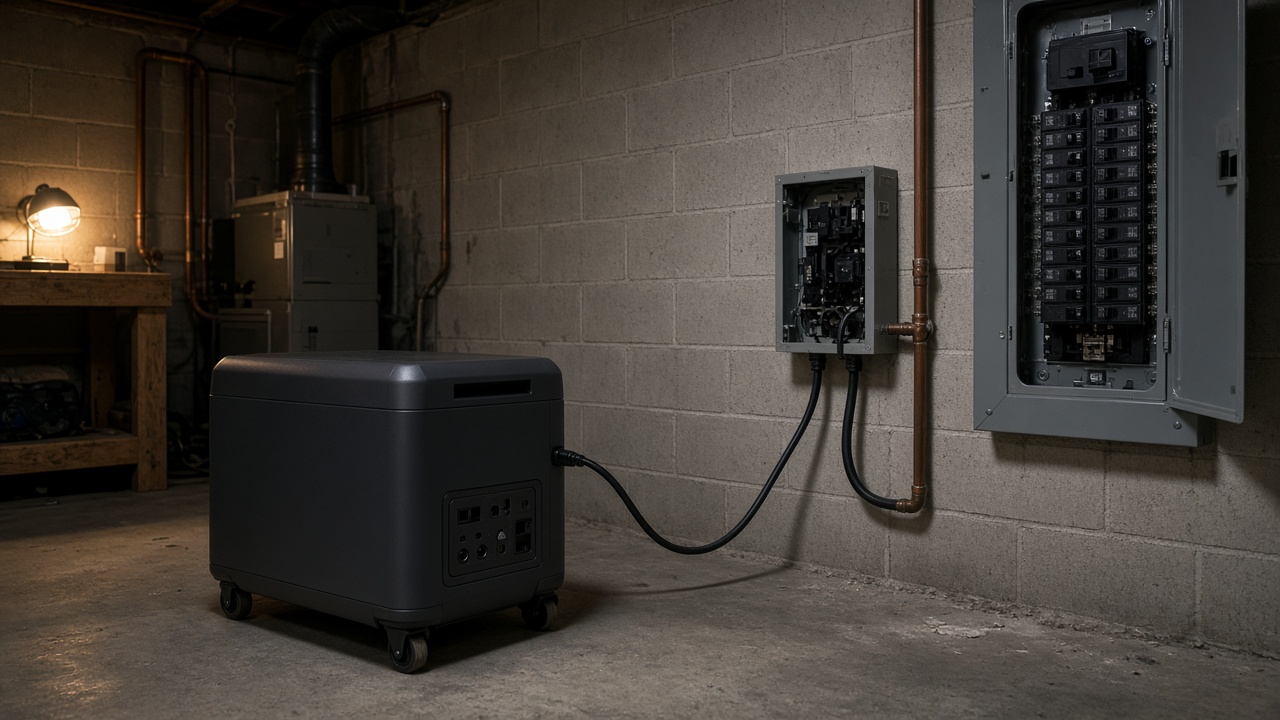
Do You Need a Transfer Switch for a Home Backup Battery?
A home backup battery is not automatically a backup system for the house. The overlooked decision is how power reaches the appliances: cords, a selected-circuit transfer switch, or an installed whole-home path.
Read guide